Imagine you are walking through the heart of Delhi or Mumbai.
Above you, a massive, unmissable 60-foot hoarding glows with the image of a new premium electric vehicle. It is bold. It is permanent. It is dominating the skyline.
Ten minutes later, you check your phone. You see a tiny banner ad for another car brand sandwiched between a fake news headline and a generic meme.
Which brand do you trust more?
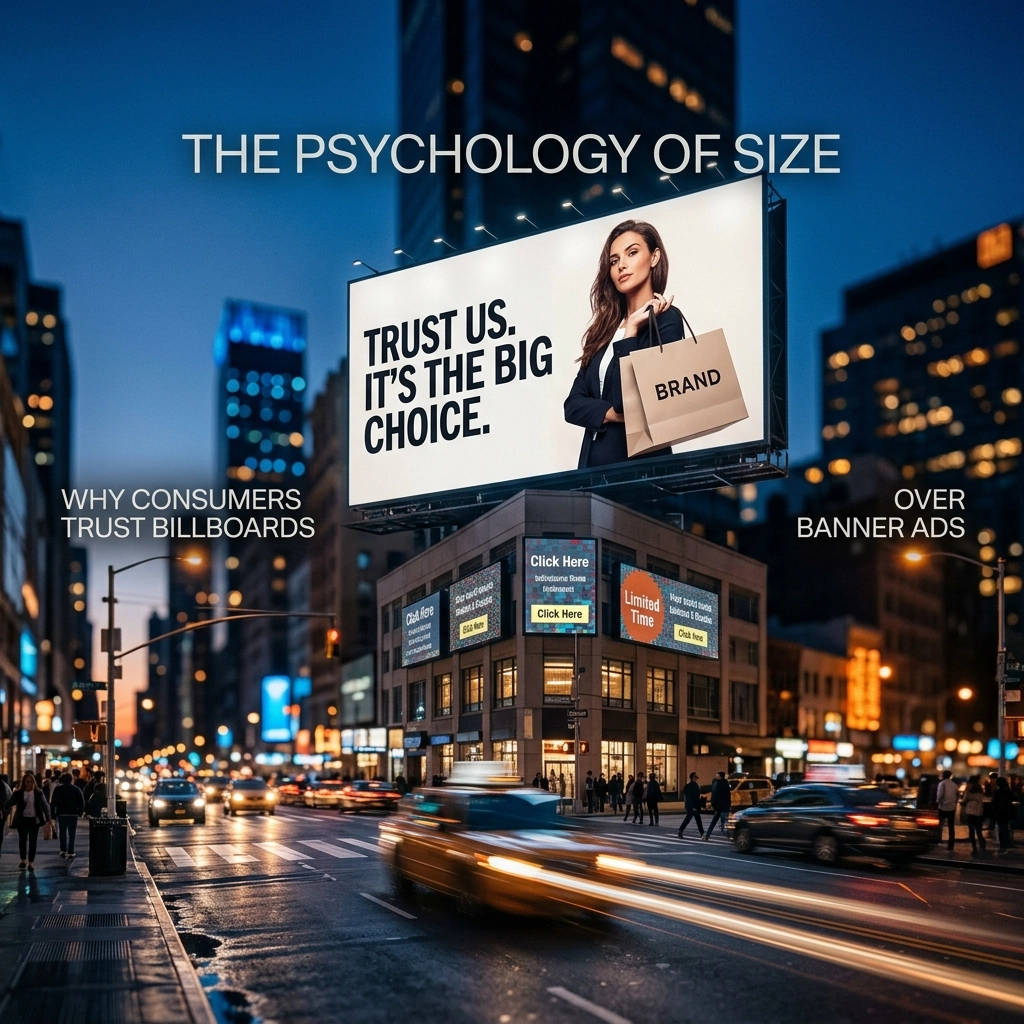
The answer is almost always the one on the billboard. This isn't an accident. It is the Psychology of Size at work.
In an era where digital spaces are cluttered with scams and low-quality content, the physical vs digital marketing trust gap is widening. For brand strategists and founders, understanding this shift is the key to premium brand positioning.
Defining the "Psychology of Size"
In the advertising world, size is more than just a measurement. It is a psychological signal.
The Psychology of Size refers to the cognitive shortcut where the human brain equates physical scale with financial stability, market leadership, and authority.
When your brand occupies a massive physical space, it sends a subconscious message: "We have the resources to be here. We are not a fly-by-night operation. We are a leader."
This concept is rooted in Costly Signaling Theory. Just as a peacock grows a heavy, vibrant tail to prove its fitness, a brand buys a massive billboard to prove its market dominance.
Digital ads, while effective for conversion, often lack this "trust signal" because the barrier to entry is so low.

The Trust Gap: ₹500 vs. The Massive Hoarding
Today, anyone with a credit card and ₹500 can run a targeted social media ad.
While this democratizes advertising, it also dilutes brand trust advertising. Because the cost of entry is negligible, the perceived risk of the brand being a scam or a low-quality product is higher in the digital realm.
Building brand authority requires a different approach.
1. The Signal of Stability
A billboard is a public commitment. You cannot "delete" a physical hoarding if a customer leaves a bad review. It stands there, day and night, for weeks or months. This physical permanence signals to the consumer that your brand is stable and here to stay.
2. Eliminating Cognitive Clutter
Digital banner ads are often surrounded by distractions: notifications, competing ads, and "skip" buttons. A billboard, however, offers an uninterrupted moment of engagement. By dominating the screen of the real world, you reduce cognitive load and create a stronger memory trace.
3. The Authority of Shared Experience
Digital ads are private. Only you see your specific algorithmically-targeted ad. A billboard is a shared experience. Everyone in the city sees it. This creates a "social proof" effect where consumers trust the brand because they know everyone else knows about it too.
The Evolution of OOH: From Static to "Phygital"
We are currently witnessing a revolution in how outdoor media functions.
The future of advertising isn't just about size; it’s about the integration of physical presence with digital intelligence. This is what we call "Phygital" marketing.
- Programmatic DOOH: Digital Out-of-Home (DOOH) is making outdoor advertising as trackable as digital while retaining its massive physical impact. You can read more about the rise of programmatic DOOH in India to see how data meets scale.
- Anamorphic 3D Designs: Larger-than-life 3D visuals on corner buildings are turning hoardings into viral sensations.
- Omnichannel Consistency: Brands that use OOH to anchor their digital campaigns see a significant lift in trust and conversion rates.

Actionable Steps: How to Build Brand Authority Through Size
If you are looking to elevate your brand’s perceived value, follow these steps to master the psychology of size:
- Choose High-Impact Locations: Don't just buy any space. Target "Iconic" spots that naturally associate your brand with success and luxury.
- Prioritize Simple, Bold Copy: Size allows for clarity. Use large fonts and high-contrast visuals. If a consumer can’t understand your message in 3 seconds, the size is wasted.
- Invest in Quality Production: A poorly maintained or low-resolution hoarding can actually damage trust. Ensure your physical presence reflects your premium brand positioning.
- Leverage the "Halo Effect": Use your massive OOH presence as the centerpiece of your social media strategy. A photo of your billboard on Instagram is worth more than a standard digital post because it proves your brand’s "real-world" status.
- Avoid These Mistakes: Even the biggest ad can fail if executed poorly. Check out our guide on 7 mistakes you’re making with billboard advertising to stay ahead.
The Data: Why the Numbers Favor OOH
The effectiveness of OOH is backed by more than just theory; the data is undeniable.
- Recognition Rate: Billboards boast an 86% recognition rate, significantly higher than digital banner ads which are often ignored due to "banner blindness."
- Consumer Notice: Research shows that 71% of people consciously notice billboards while traveling.
- Trust Levels: Physical ads are consistently ranked as more trustworthy than social media or pop-up ads by consumers across all age demographics.
- Recall Power: Emotionally engaging OOH ads are remembered nearly 2x more than fact-based digital ads.
Case Study: Dominating the Urban Landscape
Goal: A rising fintech brand wanted to transition from being seen as a "risky startup" to a "trusted financial institution."
Execution: Instead of increasing their digital ad spend, they pivoted 40% of their budget into a high-visibility OOH campaign. They took over premium hoardings in financial districts and along major commuter routes in Delhi and Mumbai. The creative featured minimal text, bold brand colors, and a clear message of "Security First."
Result: Within three months, the brand saw a 35% increase in brand trust scores in consumer surveys. Their organic search volume grew by 50%, as users who saw the "unmissable" boards searched for the brand later. By going big, they effectively bypassed the trust barrier that keeps many digital-only brands stagnant.

Frequently Asked Questions (FAQs)
Is OOH only for big brands with massive budgets?
Not at all. While "going big" helps with authority, even local brands can use the psychology of size on a neighborhood scale. The key is to be the dominating presence in your specific geographic area.
How do I measure the ROI of a billboard compared to a digital ad?
The ROI of OOH is measured through brand lift, search volume increases, and footfall attribution. With the evolution of tracking technology, we can now link billboard exposure to website visits and store entries.
Why do people ignore digital ads but look at billboards?
This is due to "banner blindness." Our brains have learned to filter out the clutter on our screens. However, in the physical world, a massive object is a biological trigger for attention. You cannot "ad-block" a 40-foot hoarding.
Does the material of the billboard affect trust?
Yes. Quality matters. A vibrant, well-lit digital screen or a clean, tensioned vinyl hoarding signals professionalism. A faded or torn ad signals neglect.
Elevate Your Presence Today
The digital landscape is becoming more crowded and less trusted every day. To stand out, you must step out: into the physical world.
Size is not just about being seen; it is about being believed. When you own the skyline, you own the conversation.
Are you ready to lead the revolution and build undeniable authority?
Explore why your brand needs to go big with hoarding advertising.
At Graphisads, we specialize in making brands unmissable. Let’s build your legacy in the real world.