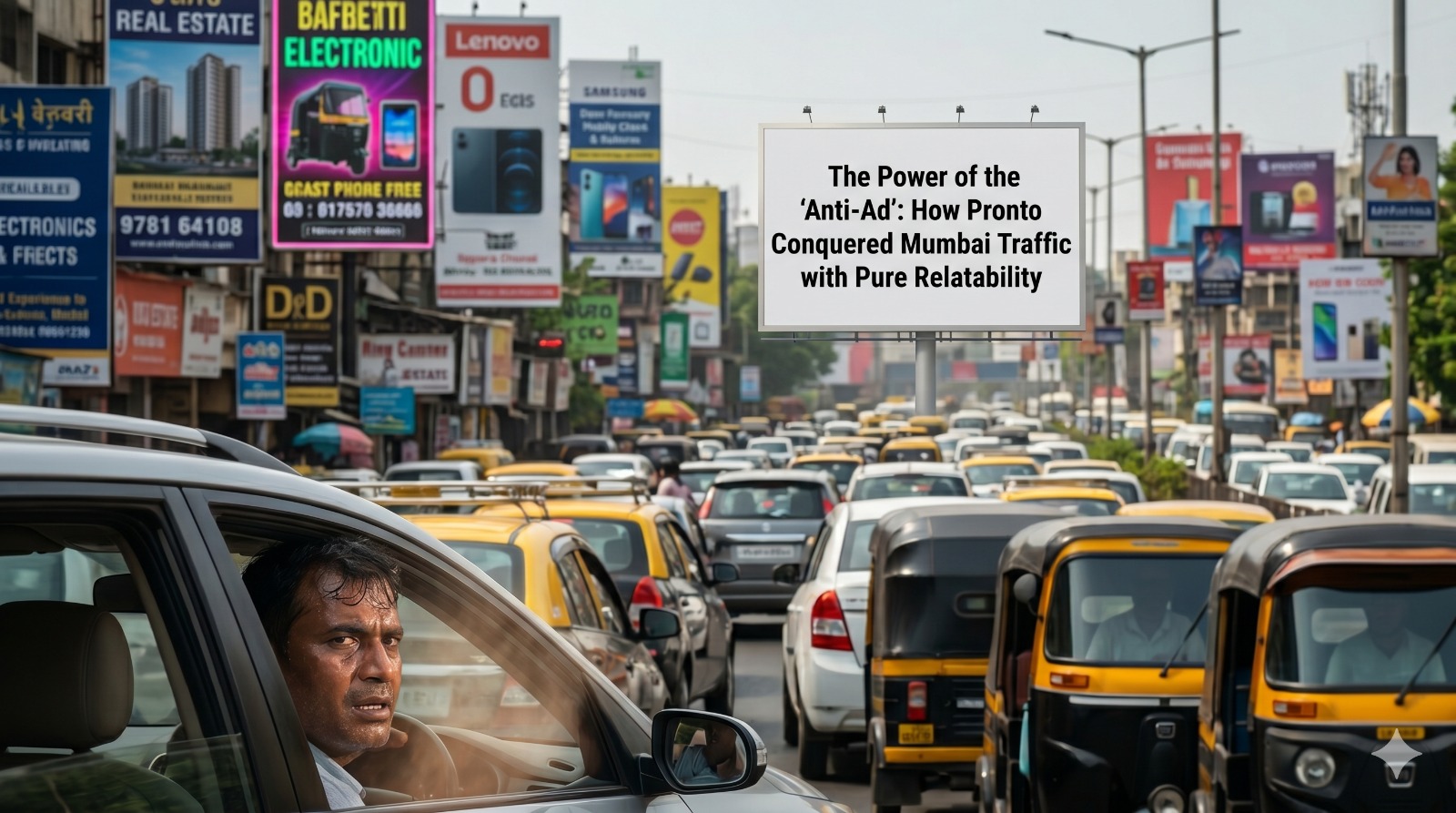
Imagine you are sitting in a gridlock on the Bandra Western Express Highway.
The sun is beating down, your AC is struggling, and your phone is buzzing with a Zoom invite for a meeting that started five minutes ago.
You look up, and you see a sea of neon.
A dozen billboards are screaming at you to buy a luxury flat you can’t afford, a smartphone you already own, and a protein shake that promises a six-pack by Sunday.
You stop looking. You tune it out. You’ve developed “ad blindness.”
Then, you see a plain, white hoarding with simple black text.
It doesn’t ask you to buy anything. It doesn’t offer a 20% discount.
Instead, it says: “Trying to coordinate the plumber between back-to-back WFH calls and the 4 PM society water cut is a full-time job.”
You smile. You take a photo. You post it on Instagram.
This is the evolution of the “Anti-Ad,” and it is currently dominating the landscape of Mumbai.
What is an Anti-Ad? The Revolution of Relatability
The Anti-Ad is a tactical rebellion against traditional marketing.
It is a revolution in communication that prioritizes human connection over the hard sell.
While traditional outdoor-media-advertising focuses on features and benefits, the Anti-Ad focuses on the shared human experience.
It’s about being “unmissable” by being remarkably quiet.
In the Urban Hustle of a city like Mumbai, where cognitive load is at an all-time high, the Anti-Ad acts as a psychological palate cleanser.
It doesn’t demand your attention; it earns your empathy.
By stripping away the “corporate” voice, your brand becomes a person, a friend, or a fellow sufferer of the daily grind.
The Value Proposition: Why “Less” is the Next Chapter of “More”
Why does a minimalist board outperform a high-budget visual spectacle?
The answer lies in the future of consumer psychology.
Modern audiences, especially in high-growth markets, are skeptical of polished corporate messaging.
They crave authenticity. They want to know that your brand “gets” them.
When you use an Anti-Ad strategy, you are:
- Cutting through the noise: In a world of visual clutter, the absence of design becomes the design.
- Building trust: By acknowledging a problem without immediately pushing a solution, you establish a rapport.
- Encouraging organic reach: People don’t share ads; they share stories and relatable moments.
- Creating a “Smart” brand image: It shows you are confident enough not to scream.
This strategy is dominating the Mumbai advertising scene because it respects the viewer’s intelligence.
It acknowledges the Urban Hustle rather than trying to distract from it.
Trends: Minimalism and the Future of OOH
We are witnessing a global shift toward minimalism in OOH.
The evolution of the billboard is moving away from the “bigger is better” philosophy toward the “smarter is better” approach.
Data from recent campaigns suggests that text-heavy, high-context billboards have a 40% higher recall rate than standard product-hero imagery in high-traffic zones.
This is because the brain processes relatable text as a “conversation” rather than an “intrusion.”
The future of advertising isn’t about the brightest LED; it’s about the most relevant thought.

Actionable Steps: How to Simplify Your Strategy
If you want your brand to lead the next revolution in media, you need to strip back.
Here is how you can implement an Anti-Ad strategy for your next campaign:
- Identify the Pain Point: What is the one thing your audience is complaining about right now?
- Strip the Design: Remove the logos (or make them tiny), remove the stock photos, and remove the “Call Now” buttons.
- Find the “Quiet” Voice: Write like you are texting a friend. Avoid marketing jargon like “synergy,” “best-in-class,” or “premium.”
- Target the Location: Context is everything. A billboard about WFH stress works best on a road leading to a tech park or a residential hub like Andheri or Powai.
- Measure the Sentiment: Use real-time analytics to see how many people are talking about the ad, not just looking at it. You can learn more about this at decoding the real-time analytics of modern OOH.
Case Study: Pronto’s Minimalist “Anti-Ad” (Mumbai)
The Goal:
Pronto, a house-help and repair startup, wanted to increase brand awareness in Mumbai without appearing like another “utility” app. They needed to capture the attention of busy professionals who are often too overwhelmed to look at traditional ads.
The Execution:
Instead of showing a picture of a smiling plumber or a sparkling clean house, Pronto erected a series of simple black-and-white billboards.
The copy read: “Society rules say no drilling after 6 PM. Your boss says the meeting starts at 6 PM. We say, just call Pronto for the morning slot.”
Another stated the exhausting reality of managing domestic help while navigating the Urban Hustle. No flashy colors. No celebrity brand ambassadors. Just plain text on a white background, strategically placed in the middle of heavy Mumbai traffic.
The Result:
The campaign went viral within 48 hours.
Commuters began taking photos of the hoardings and sharing them on LinkedIn and Instagram.
The “Anti-Ad” achieved:
- 300% increase in organic social media mentions.
- 50% growth in app downloads during the campaign period.
- Unbeatable brand sentiment scores, as users felt the brand “finally understood” their daily struggles.
Pronto didn’t just sell a service; they started a conversation about the Mumbai lifestyle.
Frequently Asked Questions (FAQs)
Q: Won’t people miss my brand name if it’s too small?
A: Actually, the opposite is true. When a piece of content is relatable, people will actively search for who created it. It creates a “pull” effect rather than a “push” effect.
Q: Is this only for startups like Pronto?
A: Not at all. Legacy brands can use Anti-Ads to modernize their image and appear more approachable. It’s about the message, not the company size.
Q: Can we use this on digital screens?
A: Yes, but keep it static. The power of the Anti-Ad is its stillness. Motion can sometimes break the “relatability” spell.
Q: Does it work outside of Mumbai?
A: The “Anti-Ad” works anywhere there is high consumer fatigue. Whether it’s the Urban Hustle of Delhi or the tech-stress of Bangalore, relatability is a universal currency.
Q: How do we know if our copy is “Anti-Ad” enough?
A: Read it out loud. If it sounds like something a person would actually say at a dinner party, you’re on the right track. If it sounds like a brochure, start over.
Lead the Revolution: Simplify Your Strategy Today
The era of shouting is over. The era of understanding has begun.
Your brand has the potential to be more than just a logo on a highway; it can be the highlight of someone’s commute.
By embracing the “Anti-Ad” philosophy, you aren’t just buying space; you are buying mindshare.
Stop competing for eye-rolls and start competing for smiles.
Revolutionize your presence.
Dominating the market starts with a single, simple, relatable thought.
Ready to cut through the noise? Lead the revolution with Graphisads.